



Junior Cycle CBAs
Understanding the Junior Cycle
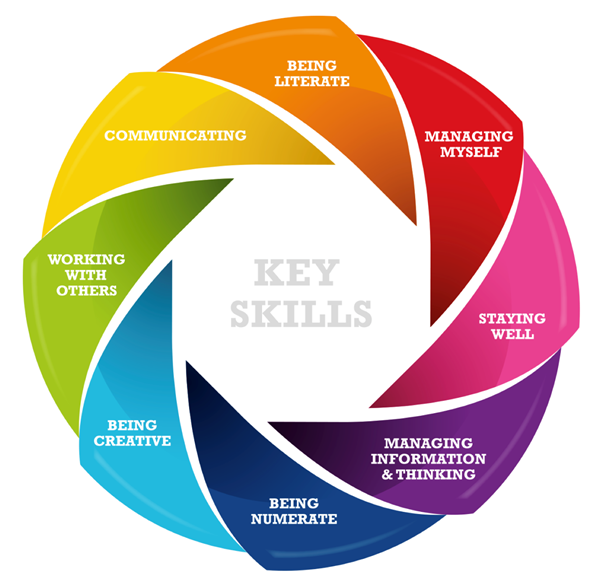
From 2022, all Junior Cycle subjects and short courses have been revised and the old Junior Certificate has been fully phased out. The Junior Cycle places a focus on key skills and has a new approach to both assessment and reporting.
What students will study in the Junior Cycle
In the Junior Cycle, students will study several Full subjects, the following subjects are compulsory:
- English
- Gaeilge
- Maths
- History
Students will study a minimum of 240 hours of English, Gaeilge and Maths over the three years, while all other full subjects require a minimum of 200 hours.
| Core Subjects | Elective Subjects | Wellbeing Programme |
| English | Art | CSPE |
| Irish | Business Studies | Guidance |
| Maths | Home Economics | PE |
| French/Spanish | Music | SPHE |
| Geography | ||
| History | ||
| Religious Education | ||
| Science |
A central theme of the Junior Cycle is a significant Wellbeing Programme containing subjects such as SPHE, CSPE & PE which is to make up a minimum of 400 hours throughout the three-year Junior Cycle.
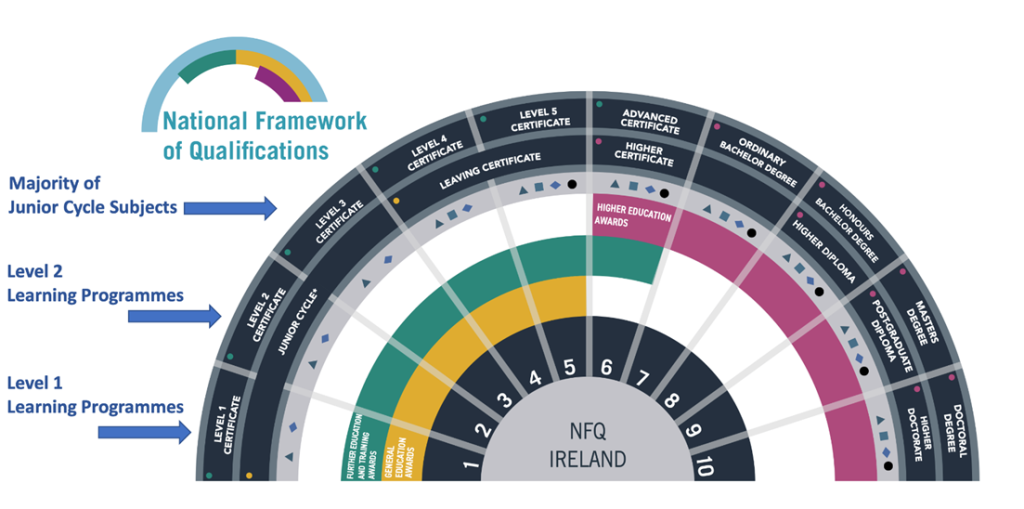
The majority of students will study these subjects which are located at Level 3 on the National Framework of Qualifications (NFQ). For students who may struggle at this level, an additional range of subjects known as Learning Programmes (L2LPs & L1LPs) has been designed which are at both Level 2 and Level 1 on the NFQ respectively
Assessment in the Junior Cycle
There are three main ways that students will be assessed in the new Junior Cycle.
– Terminal exams
– Classroom-Based Assessments (CBAs)
– Assessment Tasks (have not taken place since Covid 19)
Terminal exams
In the full subjects, students will sit a terminal exam at the end of their 3rd year. There will only be one paper per subject and these will range from 1.5 to 2 hours. Only English, Maths and Gaeilge will be offered at both Higher and Ordinary level, all other subjects are studied at Common level. There will be no Foundation Level exams.
The grading classification of the terminal examinations is shown below:
| Junior Cycle Grade Classification | |
| Percentage | Grade Descriptor |
| >85-100 | Distinction |
| 84-70 | Higher Merit |
| 69-55 | Merit |
| 54-40 | Achieved |
| 20- 39 | Partially Achieved |
| 0-19 | Not graded |
Classroom-Based Assessments (CBAs)
Classroom-Based Assessments are short projects completed in the 2nd and 3rd year where students can demonstrate their learning and skills in ways not possible in a pen and paper examination, for example, their verbal communication and investigation skills.
As the name suggests, CBAs take place in the classroom when all other students are present. Students can decide on the topic of their CBAs with the help of their teachers and are given three weeks to complete them. The CBAs are then graded by the subject teachers at a common level. In Practical classes, the second CBA may take the form of a piece of practical work and this will be marked by the State Examinations Commission in the normal way.
In the Classroom-Based Assessments, students will receive one of the following descriptors-
| Classroom-based Assessment Descriptors |
| Exceptional |
| Above Expectations |
| In Line with Expectations |
| Yet to meet Expectations |
Level 2 Learning Programmes (L2LPs)
Some subjects within the new Junior Cycle may prove too difficult for a small number of students so a range of new Level 2 Learning Programmes have been designed. These programmes will provide students with some more accessible courses that will allow them to also have some success in these subjects.
Level 1 Learning Programmes (L1LPs)
For students with particular special educational needs, other short courses which are made up of Priority Learning Units have been designed called L1LPs. These students would have an existing individual education plan and would most likely be in a special class placement within a special school or mainstream school setting.
The assessment elements listed above will then be joined, for the first time, by those other activities and achievements of school life that are integral to a student’s holistic learning journey throughout the three years of the Junior Cycle. These additional learning experiences are called Other Areas of Learning and Other Areas of Wellbeing. Everything will then be detailed on an enhanced form of certification called the Junior Cycle Profile of Achievement (JCPA).