



Senior Cycle
Core Subjects
Elective Subjects
Students choose 4 elective subjects
Understanding the Senior Cycle
The Senior Cycle is the final stage of post-primary education in Ireland and is usually completed over two years (5th and 6th Year). It builds on the learning, skills and experiences developed during Junior Cycle and, where taken, Transition Year.
Senior Cycle programmes aim to prepare students for further education, training, apprenticeships, or employment, while supporting their academic, personal and social development. Students are encouraged to take greater responsibility for their learning and to make informed decisions about subject choices and future pathways.
The Senior Cycle culminates in the Leaving Certificate examinations, which play an important role in access to higher education and career opportunities.
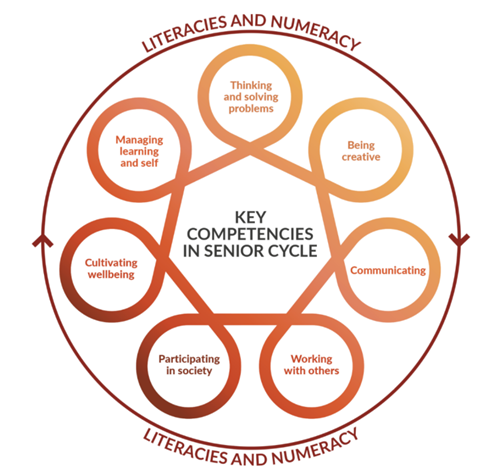
Senior Cycle – Key Competencies
In Senior Cycle, students continue to develop the key competencies — the knowledge, skills, values and dispositions needed to participate fully in education, work, society and lifelong learning. These competencies are developed across all subjects and learning experiences, supporting students to become confident, capable, creative and responsible learners, well prepared for life beyond school.
Assessment in the Senior Cycle
Assessment in the Senior Cycle is designed to support and reflect students’ learning as it develops over time, while also providing a reliable record of achievement at the end of post-primary education.
Traditionally, Senior Cycle assessment has been externally assessed, with students completing written, oral and practical examinations as part of the Leaving Certificate at the end of 6th Year. These assessments continue to play an important role in recognising student achievement and supporting progression to further education, training and employment.
However, Senior Cycle assessment is currently undergoing redevelopment. In line with national reform, there is an increasing emphasis on a broader range of assessment approaches that better capture the full range of students’ learning, skills and competencies. This includes greater use of:
- Project and coursework components (40%)
- Practical, oral and performance-based assessments
These developments aim to provide a more balanced and inclusive assessment system, allowing students to demonstrate their learning in different ways while continuing to maintain high standards and clear certification.
As national changes are introduced, assessment in Senior Cycle will continue to align with Junior Cycle principles, supporting continuity, progression and the development of key competencies that prepare students for life beyond school
Inclusive Senior Cycle Pathways
In addition to the established Leaving Certificate programmes, Senior Cycle Level 1 and Level 2 Learning Programmes are being developed to support students with additional learning needs. These programmes focus on:
- Preparing students for life after school
- Developing independence and communication skills
- Supporting meaningful participation in the community
These pathways ensure that Senior Cycle education is accessible, inclusive and relevant for all learners